Contact Us
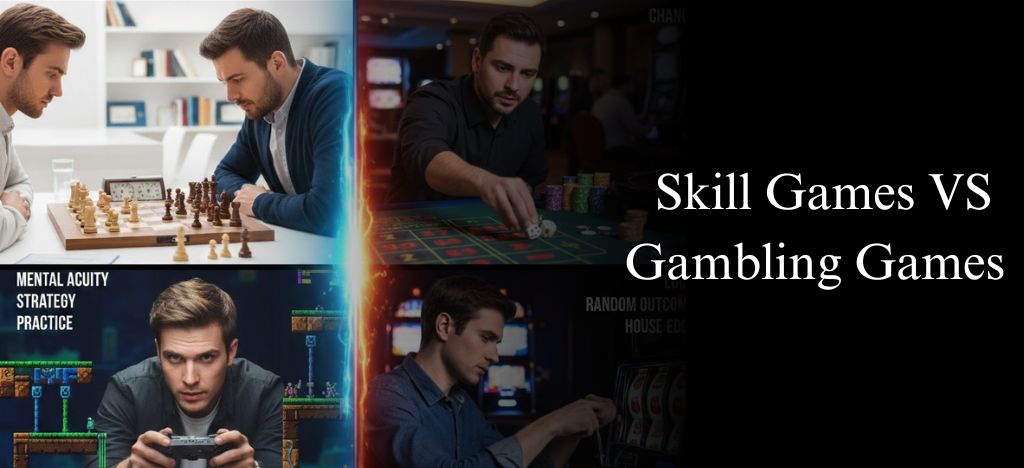
Skill Games VS Gambling Games: What’s the Difference

The discussion about Skill Games VS Gambling Games has existed for many years.
The two activities share common elements of risk and competition and reward systems but they exhibit major differences in their outcome determination methods and their regulatory frameworks which apply to different regions.
For players and developers and gaming entrepreneurs understanding this distinction is essential. This guide explains the differences between skill-based games and gambling games and their outcome determination methods and their importance to current digital gaming.
What Are Skill Games?
Players in skill games need to use their abilities and knowledge and mental or physical competencies and strategic thinking to achieve victory.
Players in skill-based games can enhance their skills through practice and learning and by choosing their strategies.
Key Characteristics of Skill Games:
- Outcome depends largely on player expertise
- Experience improves winning probability
- Strategic thinking and decision-making processes determine game outcomes
- Competitive balance matters
- Luck plays a minimal or secondary role
Examples of Skill Games
Some common examples include:
- Chess
- Esports competitions
- Fantasy sports contests
- Certain card strategy games
A highly skilled player in these games achieves superior performance when compared to a beginner.
What Are Gambling Games?

Gambling games serve as entertainment which lets players bet on results which mostly depend on random events. games that use multiple formats show that players need to develop strategies yet random events become the main determining factor for success.
The games use systems which include random number generators (RNG) together with physical randomness systems that operate from shuffled decks and spinning wheels.
Key Characteristics of Gambling Games:
- Outcome depends mostly on chance
- Limited influence from player decisions
- Randomized systems determine results
- Short-term unpredictability is high
- House edge or statistical advantage exists
Examples of Gambling Games
Common examples include:
- Roulette
- Slot machines
- Lottery games
- Certain casino card games
The games show that players cannot create successful outcomes through skill since all results depend on chance.
Core Difference: Skill vs Chance
The primary difference in the Skill Games VS Gambling Games comparison lies in the dominant factor that determines the outcome.
| Factor | Skill Games | Gambling Games |
|---|---|---|
| Outcome Control | Player-driven | Chance-driven |
| Role of Practice | Improves results | Minimal impact |
| Predictability | Performance improves over time | Outcomes remain random |
| Strategy Impact | High | Low to moderate |
| Statistical Edge | Skilled players gain advantage | House usually has edge |
In skill games, long-term performance reflects player expertise. In gambling games, long-term mathematical probability governs outcomes.
The Role of Probability and Mathematics
Both skill games and gambling games involve probability — but in different ways.
In skill games:
- Probability can be influenced through strategic decisions.
- Risk management and analytical thinking matter.
In gambling games:
- Probability is fixed.
- Random algorithms or physical randomness control results.
- The expected value typically favors the operator over time.
Players need this understanding because it helps them assess potential risks along with expected rewards.
Psychological and Behavioral Differences
Psychological involvement serves as an essential component in the Skill Games vs Gambling Games discussion.
Skill Games Encourage:
- Players develop their capacity to think through complex problems
- Players compete against each other
- Players develop their skills for their whole life
- Players pursue their goal to achieve complete expertise
Gambling Games Trigger:
- Players experience excitement when they see unpredictable results
- Players start to take risks
- Players expect to gain benefits within quick timeframes
- Players wait to see which outcome will happen because of chance
Both game categories provide entertainment value but people choose to play different games because of their distinct reasons.
Regulatory Differences Around the World
Worldwide regulatory authorities use the "dominant factor test" to separate skill-based gaming from gambling because they need to determine which skill or chance element controls game results.
Many jurisdictions:
- Apply stricter rules to regulate gambling games
- Require operators who handle chance-based betting systems to obtain licenses
- They apply taxation according to the specific game type.
Countries and regions establish their own laws which show extreme variation from one area to another. People who want to start or take part in online gaming need to understand the local laws that apply to their activities.
Business Model Differences
The two business models use different methods to generate their revenue.
Skill Game Models:
- Tournaments require players to pay an entry fee
- Users pay for access to content through subscription
- Users can buy additional digital content
- Companies use advertising to generate revenue
- Platforms take a percentage of revenue from their transactions
Gambling Game Models:
- The house commission system creates a profit for the casino
- The betting system creates profit through its margin
- The system generates income when players place bets
Skill-based platforms create competitive environments to maintain player involvement while gambling platforms depend on betting activity and their profit margins.
Overlap: Games That Combine Skill and Chance
Some games exist in a gray area which both skill and chance create. For example:
- Certain card games
- Fantasy sports formats
- Competitive strategy games with randomized elements
The system establishes player outcome results through the evaluation of player decision-making authority. The evaluation process requires courts and regulators to assess each situation individually.
Why Understanding the Difference Matters
The distinction between Skill Games VS Gambling Games matters because it impacts:
- Legal frameworks
- Taxation
- Advertising policies
- Payment processing rules
- Platform compliance requirements
The classification system provides developers and operators with guidelines to create responsible gaming systems. The players need to comprehend the system operations which help them make decisions.
Final Thoughts
The discussion about Skill Games VS Gambling Games extends beyond entertainment because it involves control and probability and future results.
Skill games reward mastery, learning, and strategy. Gambling games depend on random events and probability systems. The two systems create different player experiences because they operate under different fundamental rules.
The distinction between these two systems which defines digital gaming today requires understanding from both online players and gaming business owners.